One Battle After Another: The Generation Defining Blockbuster
EDITORS' PICK
-
EDITORS' PICK -
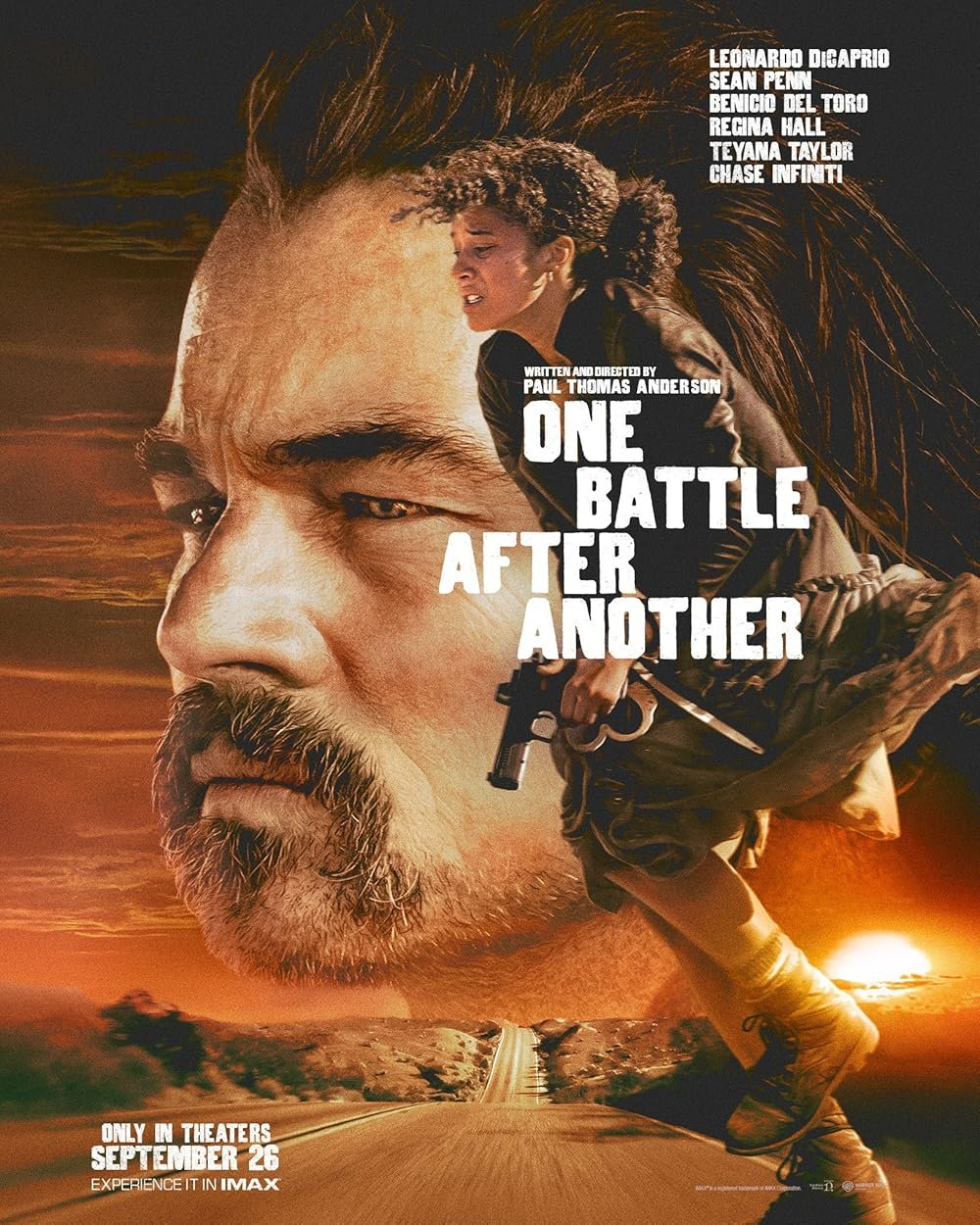
Image - IMDb
Recently, I had the opportunity to watch Paul Thomas Anderson's new masterpiece, One Battle After Another, in IMAX 70MM. If you're not familiar with Paul Thomas Anderson's work, he has directed masterpieces such as Boogie Nights, Magnolia, Punch-Drunk Love, The Master, There Will Be Blood, Phantom Thread, and others.
Up until now, Anderson had only made one other movie set in the 21st century, which also happens to be my favorite of his. Punch-Drunk Love is a love story about a plunger salesman who gets extorted by a phone sexline scam operation and shares possibly one of the most iconic kisses in any movie ever to a Shelley Duvall song. After that came a story about the birth of American capitalism set in the late 19th century, a post-war fable of a troubled veteran who joins a newly founded religion, a stoner noir comedy/mystery set at the end of the 1960s and the beginning of the 1970s, a mid-century tale of a dressmaker and his muse's volatile relationship, and then finally a romance set during the 1973 oil crisis. The point is that, until now, Anderson seemed disinterested in making any movies set in the modern day.
But then came his colossal new movie, One Battle After Another, a generation-defining blockbuster about an ex-revolutionary Bob Ferguson (Leonardo DiCaprio) trying to save his daughter Willa Ferguson (Chase Infiniti) after his old nemesis Steven J. Lockjaw (Sean Penn) kidnaps her. Vaguely adapted from Thomas Pynchon's novel Vineland, but set in modern-day America rather than 1984, this powerful, hilarious, comedy-thriller blockbuster confronts our country with its prophetic story of immigration detention centers, caricatures of white nationalists, corrupt politicians, and fascists.
Watching One Battle After Another in IMAX 70mm was immensely overwhelming but in the best way possible. Anderson stretches his filmmaking into these huge, colossal images without losing his knack for those small and human details. Everything feels so impossibly wide, yet the camera is always able to find our main characters, like Bob, at the center, reminding us that this is an intimate story disguised as a blockbuster. There's a car chase that occurs towards the end of the movie, where the camera rolls over hilly roads in a slow and almost meditative way, accompanied by an incredible score in the background. It completely entranced me, and it may be the scene I think about most from this movie.
The score is truly incredible. It’s done by Jonny Greenwood (the guitarist and keyboardist of Radiohead), who has done six other scores for Anderson: There Will Be Blood, The Master, Inherent Vice, Phantom Thread, and Licorice Pizza. While I don't know if this score is quite as good as some of the others, such as Phantom Thread, which might genuinely have the best piece of score ever ("House of Woodcock"), it’s still exceptional. Every single piece is played at the perfect moment, and every time the central title theme played, I was almost moved to tears.
What makes One Battle After Another feel so powerful, though, are the stellar performances. Anderson gives us these characters who the spectacle could so easily swallow, and yet each actor brings such rawness and emotional depth that they’re able to cut right through the film’s colossal scale. Leonardo DiCaprio really pulls off one of his best performances as Bob Ferguson here, possibly even his best. He perfectly depicts a weird, stoned, and paranoid dad. He’s able to pull off a passionate revolutionary but can also anchor his role in the love a father has for his daughter. It’s incredible. Chase Infiniti’s performance as Willa was truly exceptional. It’s almost hard to believe that this was her first-ever acting role. Her performance truly shines in her facial expressions; they’re subtle yet heartbreaking. There’s one scene where she’s getting kidnapped by a soldier, and she has the saddest look of defeat and terror on her face. It just absolutely destroyed me when I saw it. Benicio Del Toro as Sensei, Willa’s mentor in the film, absolutely deserves a mention too; he brings this calm and warm demeanor that provides a pause amid all of the chaos, embodying the kind of wisdom and clarity that Willa may carry forward.
Ultimately, and I think this is evident in the ending, One Battle After Another is about how the fight for peace continues on with the next generation picking up where the last one failed; the film insists it is worthwhile to try to at least leave the world a little better than how you found it. The narrative frames Willa’s final choice in relation to Sensei, who the film depicts as a model of sustainable and community-based activism. He’s someone who contrasts her parent’s destructive extremes and gives Willa a different path forward. The film reminds us that while some battles may be lost, the larger fight for a just world is never over. It continues on, one battle after another.